Editorial - Trends in Bioinputs: Challenges and Opportunities
DOI:
https://doi.org/10.33837/msj.v9i1.1786Palavras-chave:
biofactory, bioprospection, biological targets, biofertilizer, biological control, sustainable controlResumo
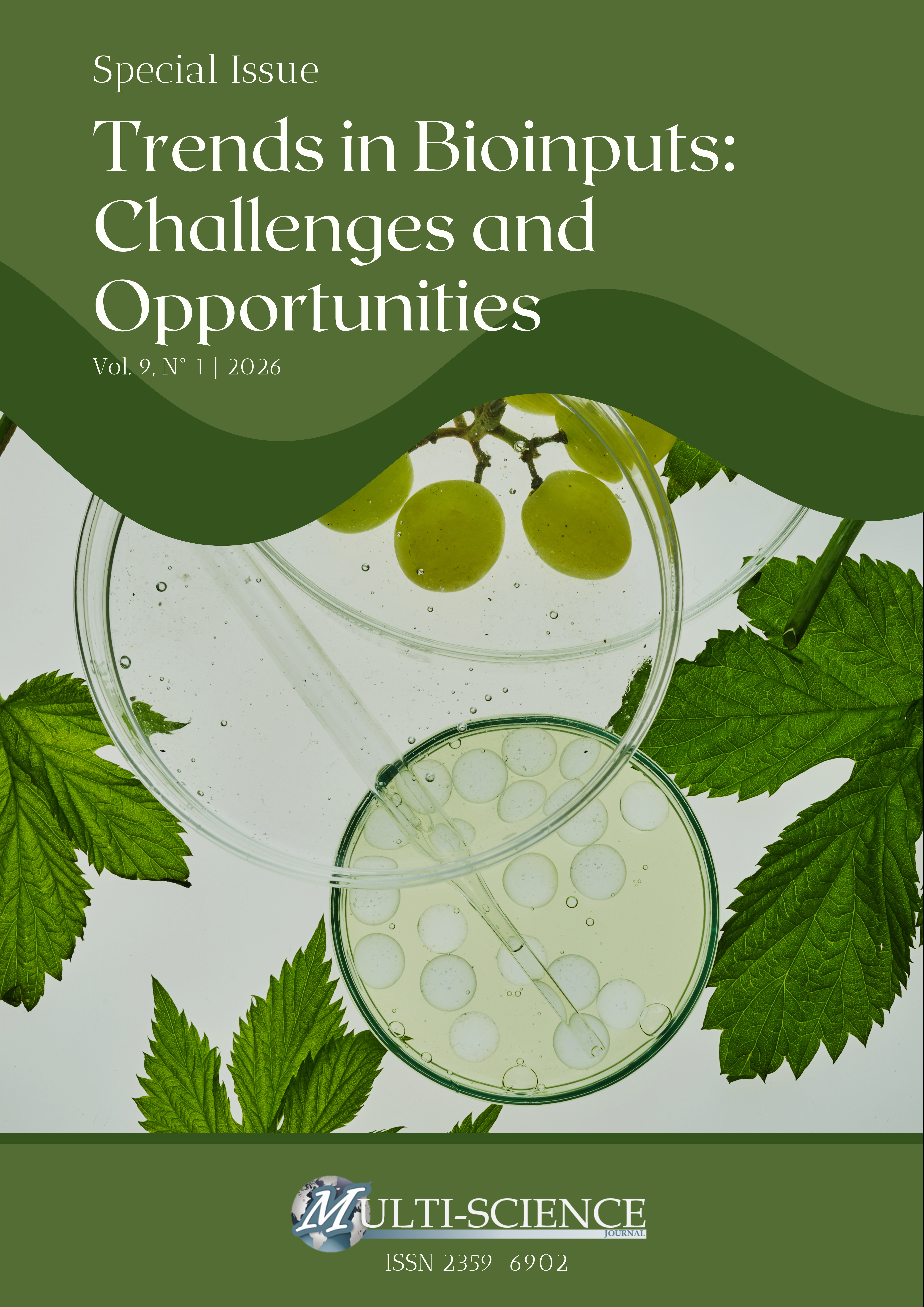
The Multi-Science Journal (ISSN 2359-6902) is pleased to present the upcoming Special Issue titled "Trends in Bioinputs: Challenges and Opportunities". In recent years, the use of bioinputs has increased significantly as a viable alternative to conventional pest control methods and synthetic pesticides in agriculture. In Brazil, initiatives under the National Program of Bioinputs, promoted by the Ministry of Agriculture, aim to stimulate economic, social, and environmental development by fostering innovation in this field. This Special Issue seeks to highlight and promote advancements in biofertilizers, biopesticides, and other biobased products. It also welcomes contributions on microbial fermentation, biomaterials, and emerging technologies associated with bioinputs.
Referências
Almeida, A. C. S., Rodrigues, M. A., Boaventura, H. A., Vieira, A. S., Silva, J. F. A., Jesus, F. G., Quintela, E. D. (2025). Can Metarhizium anisopliae reduce the feeding of the neotropical brown stink bug, Euschistus heros (Fabricius, 1798), and its damage to soybean seeds? Journal of Fungi, 11(4), 247. DOI: https://doi.org/10.3390/jof11040247
Andaló, V., Acevedo, J.P.M., Negrisoli Júnior, A.S., Dalbon, V.A. (2019). Entomopathogenic Nematodes. In: Souza, B., Vázquez, L., Marucci, R. (eds) Natural enemies of insect pests in neotropical agroecosystems. Springer, Cham. DOI: https://doi.org.ez369.periodicos.capes.gov.br/10.1007/978-3-030-24733-1_10
Barbosa, M. F., Sales, R. M. M., Galarza, F. A. D., Kruger, C. Q., Fávaro, L. C. D. L., & Quirino, B. F. (2025). Biological resources driving productivity: Bioinputs for sustainable plant agriculture in Brazil. Sustainable Microbiology, 2(3), Article qvaf011. DOI: https://doi.org/10.1093/sumbio/qvaf011
Boaventura, H. A.; Quintela, E.D. (2025). The multifunctionality of the fungus Metarhizium spp. and its use in Brazilian agriculture. Bragantia, 84, e20240183. DOI: https://doi.org/10.1590/1678-4499.20240183
Bueno, R.C.O., Carneiro, T.R., Bueno, A.F., Pratissoli, D., Fernandes, O.A., Vieira, S. S., 2010. Parasitism capacity of Telenomus remus Nixon (Hymenoptera: Scelionidae) on Spodoptera frugiperda (Smith) (Lepidoptera: Noctuidae) eggs. Brazilian Archives of Biology and Technology, 53, 133–139. DOI: https://doi.org/10.1590/S1516-89132010000100017
Corrêa, G. M., Pereira, C. S., Queiroz, A. T. S., Silva, M. P., Mello, M. E., & Oliveira, T. M. L. (2025). Use of bioinputs in sustainable agriculture: Trends, challenges and perspectives for reducing the use of agrochemicals. Journal of Social and Environmental Management, 19(5), 1-22, e011955. DOI: https://doi.org/10.24857/rgsa.v19n5-003
Costa, L.C.; Tavanti, R.F.R.; Tavanti, T.R.; Pereira, C.S. Desenvolvimento de cultivares de soja após inoculação de estirpes de Bacillus subtilis. Nativa, v.7, n.2, p.126-132, 2019. URL:https://periodicoscientificos.ufmt.br/ojs/index.php/nativa/article/view/6261
Dourado, P.M., Bacalhau, F.B., Amado, D., Carvalho, R.A., Martinelli, S., Head, G.P., & Omoto, C. (2016). High susceptibility to Cry1Ac and low resistance allele frequency reduce the risk of resistance of Helicoverpa armigera to Bt soybean in Brazil. PLOS ONE, 11(8), e0161388. DOI: https://doi.org/10.1371/journal.pone.0161388
Durán-Lara, E. F., Valderrama, A., & Marican, A. (2020). Natural organic compounds for application in organic farming. Agriculture, 10(2), 41. DOI: https://doi.org/10.3390/agriculture10020041
Faria, J. V. A.; Silva, E. C. C.; Ferreria, L. B. S.; Paz-Lima, M. L.; Xavier, J. G. M.; Leão-Araújo, E. F. Impact of biological products on soybean seed treatment: evaluation of early performance. Journal of Seed Science, v.47, e202547015, 2025. DOI: https://doi.org/10.1590/2317-1545v47290660
Feliceti, M.L.; Tozetto, L.C.; Siega, T.C.; Silva, M.; Santos, I.N.T.; Quisini, R.; Masiero, M.A.; Mazaro, S.; Possenti, J.C. Performance of soybean seeds treated with Rhizophagus intraradices mycorrhizal inoculant. Research, Society and Development, v.9, n.11, p.1-17, 2023. URL: https://rsdjournal.org/index.php/rsd/article/view/10169/9162
Glare, T. R., Goettel, M. S. and Eilenberg, J. (2010). Addendum: entomopathogenic fungi and their role in regulation of insect populations. In L. I. Gilbert and S. S. Gill (Eds), Insect Control: Biological and Synthetic Agents (p. 432-438). San Diego: Academic Press.
Lima, R.E.; Aguilera, J.G.; Zuffo, A.M.; Alves, C.Z.; Ratke, R.F.; Nogueira, G.A.; Teixeira, A.V.; Cândido, A.C.S. Qualidade de sementes de soja após a inoculação de biológicos em campo. Research, Society and Development, v.10, n.4, 2021. URL: https://rsdjournal.org/index.php/rsd/article/view/14419/12964
Oliveira, G. P. de, Soares, F. A. L., Almeida, A. C. de S., Machado, F. da C. B., Rodrigues, A. A., Sales, J. de F., & Silva, A. R. da. (2026). Thermal and X-ray imaging reveal the effects of entomopathogenic fungi on Euschistus heros. Contribuiciones a las Ciências Sociales, 19(1), e23625. DOI: https://doi.org/10.55905/revconv.19n.1-257
Oliveira, G. P., Soares, F. A. L., Sousa Almeida, A. C. D., de Souza, K. A. G., Costa Gontijo, P. D., & da Silva, A. R. (2025). Entomopathogenic fungi disrupt the feeding behavior of Euschistus heros in soybean. Scientific Reports, 16, 1261. DOI: https://dx.doi.org/10.1038/s41598-025-31096-w
Silva, J. S. L., Silva, J. H. B., Silva, A. V., Silva, L. K. P., Ferreira, J. S., Guedes, J. V. S., Santiago, M. S. T., Costa, E. N., Freitas, P. V. M., & Mielezrski, F. (2024). Use of neem vegetable cake (Azadirachta indica A. Juss) increases corn productivity. Brazilian Journal of Biology, 84, e281515. DOI: https://doi.org/10.1590/1519-6984.281515
Silveira, L.C.P., Souza, I.L., Tomazella, V.B., Mendez, H.A.G. (2019). Parasitoid Insects. In: Souza, B., Vázquez, L., Marucci, R. (eds) Natural Enemies of Insect Pests in Neotropical Agroecosystems. Springer, Cham. DOI: https://doi.org.ez369.periodicos.capes.gov.br/10.1007/978-3-030-24733-1_9
Sousa, L. M. D., Quintela, E. D., Boaventura, H. A., Silva, J. F. A. E., Tripode, B. M. D. and Miranda, J. E. (2023). Selection of entomopathogenic fungi to control stink bugs and cotton boll weevil. Pesquisa Agropecuária Tropical, 53, e76316. DOI: https://doi.org/10.1590/1983-40632023v5376316
Souza, C. M. R., de Oliveira, L. Z. S., Vaz, C. F., Bazon, J. N., Vieira, T. M., Groppo, M., Crotti, A. E. M., Dias, P. A. S., & Dias, H. J. (2025). Evaluation of biocide effects of Aloysia gratissima (Gillies & Hook.) Tronc. essential oils. Biotechnology, Agronomy, Society and Environment (BASE), 29(1), e20991. DOI: http://doi.org/10.25518/1780-4507.20991
Valicente, F.H. (2019). Bacillus thuringiensis. In: Souza, B., Vázquez, L., Marucci, R. (eds) Natural Enemies of Insect Pests in Neotropical Agroecosystems. Springer, Cham. DOI: https://doi-org.ez369.periodicos.capes.gov.br/10.1007/978-3-030-24733-1_13
Vidal, M. C., & Dias, R. P. (2023). Bioinputs based on contributions from agroecology. Brazilian Journal of Agroecology, 18(1), 171–192. DOI: https://doi.org/10.33240/rba.v18i1.23735
Downloads
Publicado
Como Citar
Edição
Seção
Licença
Copyright (c) 2026 Herbert Júnior Dias, Érica Fernandes Leão Araújo, Flávio Gonçalves de Jesus, Anderson Rodrigo da Silva, Alexandre Igor de Azevedo Pereira

Este trabalho está licenciado sob uma licença Creative Commons Attribution 4.0 International License. Autores que publicam nesta revista concordam com os seguintes termos:
- Autores mantém os direitos autorais e concedem à revista o direito de primeira publicação, com o trabalho simultaneamente licenciado sob a Licença Creative Commons Attribution que permite o compartilhamento do trabalho com reconhecimento da autoria e publicação inicial nesta revista.
- Autores têm autorização para assumir contratos adicionais separadamente, para distribuição não-exclusiva da versão do trabalho publicada nesta revista (ex.: publicar em repositório institucional ou como capítulo de livro), com reconhecimento de autoria e publicação inicial nesta revista.
- Autores têm permissão e são estimulados a publicar e distribuir seu trabalho online (ex.: em repositórios institucionais ou na sua página pessoal) a qualquer ponto antes ou durante o processo editorial, já que isso pode gerar alterações produtivas, bem como aumentar o impacto e a citação do trabalho publicado (Veja O Efeito do Acesso Livre).